

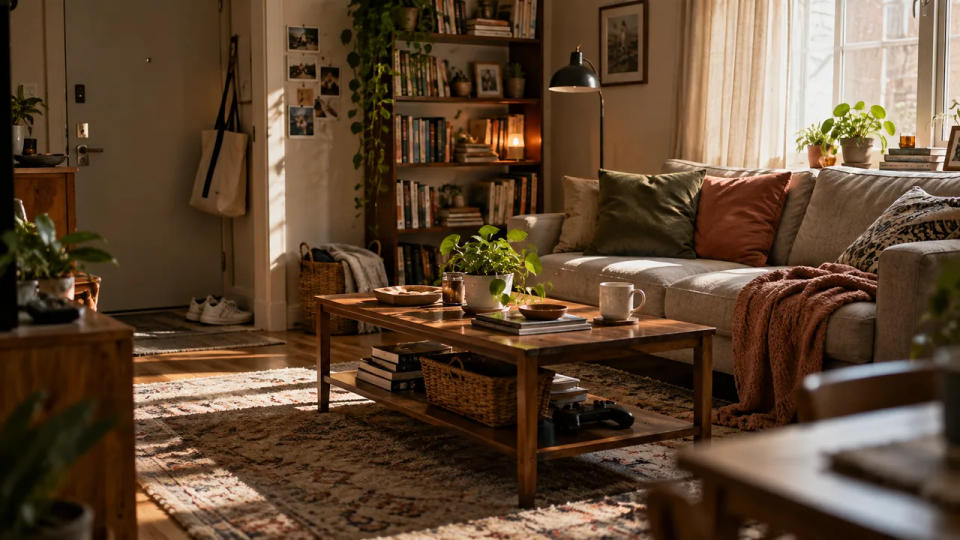
There is a particular kind of tiredness that shows up after you get home. Nothing especially bad happened on the way back. You have dinner, put down your bag, and finally sit on the sofa. Yet you still feel oddly on edge. Your eyes keep landing on the laptop beside the television, the unopened parcel by the door, and the pile of mail you meant to sort on Sunday.
It is tempting to say you are simply in a bad mood. But your home can play a part in how that mood develops. A room is not just a backdrop. It supplies light, sound, visual reminders, and familiar routines throughout the day. Some of those details make ordinary life easier. Others keep asking for a little more attention when you have none to spare.
That is why your home can affect your mood without you noticing: its surroundings shape what you pay attention to, how easily you switch between activities, and whether a particular place feels restful or demanding. The point is not to maintain a flawless house. It is to understand which everyday signals matter to you.
A room can remind you of work you have not finished
Consider an entryway. Shoes are where you left them. A shopping bag needs returning. A jacket is waiting to be washed. None of these things is a crisis. Together, though, they can make the first ten seconds at home feel like walking into another list of responsibilities.
The issue is not necessarily the number of objects. A shelf of favorite books may look busy and still feel welcoming. Three envelopes on a clean table may feel much heavier because one contains a bill you have been avoiding. What matters is the meaning you attach to what you see.
A small observational study published in Personality and Social Psychology Bulletin found associations between how people described their homes and their daily patterns of mood and cortisol. It did not prove that clutter directly causes poor mental health, but it offers a useful reminder that the experience of a home matters, not just its appearance. Read the study abstract.

This distinction is helpful if you share a home with other people. One person barely notices a stack of papers; another sees three tasks waiting to be done. Rather than debating whether the room is objectively messy, ask which visible items keep pulling your attention back toward obligations.
Light and sound change how an evening feels
Imagine arriving home on a bright Saturday afternoon. You open a window, hear ordinary neighborhood sounds, and make lunch. Now imagine the same kitchen late at night, with an overhead light glaring down and a television speaking from the next room. The furniture has not moved, but the experience of being there has changed.
Light helps the body distinguish day from night. Research on residential lighting suggests that when and how people are exposed to light can matter for sleep and well-being, although the effects vary and the evidence does not support a one-size-fits-all lighting formula. A 2023 review specifically examined light around dawn and dusk in home settings.
Sound can be just as personal. Some people find a quiet room comforting. Others prefer the low noise of a fan or music. What becomes tiring is often not sound itself but sound you cannot choose: a neighbor's television, a persistent appliance hum, traffic at bedtime, or three conversations competing at once.
Before replacing a lamp or buying a sound machine, notice what time of day you become uncomfortable. The useful question is less “Is this room relaxing?” and more “Does this room match what I am trying to do right now?”
The same corner may be asking you to play too many roles
For many people, the dining table is also a workspace, the sofa is an inbox, and the bedroom doubles as somewhere to answer late messages. That arrangement can be practical, especially in an apartment without a spare room. But it makes transitions less obvious.
You finish work, close a document, and stay seated in the same place. The laptop is still open. Your work notebook is beside the dinner plate. A message arrives, and it takes almost no effort to slip back into work mode. It is not surprising if the evening has trouble feeling different from the afternoon.
You do not need separate rooms to create a distinction. Closing the laptop, putting work papers into one drawer, or using a particular lamp only after dinner can act as a simple end-of-day marker. The action matters less as a decorating technique than as a signal: that part of the day is over.
The point is not to make every area single-purpose. It is to make changes of purpose visible enough to notice.
Familiar surroundings can soothe you—or keep you stuck in a feeling
Home is full of associations. A chipped mug may remind you of someone you love. A chair by the window may be where you read every morning. Familiar objects can help a space feel like yours, even when it would not pass a minimalist photo test.
Other associations are less pleasant. Maybe you have spent weeks working late at the same desk and now feel tense as soon as you sit there. Even a tidy space can carry uncomfortable memories.
This is one reason decorating advice often misses the point. A room that looks peaceful in a photograph might not feel peaceful to the person who lives in it. Your routines, relationships, and history contribute to the atmosphere as much as curtains and furniture do.
Try not to treat every mood change as proof that something is wrong with your home. Hunger, a difficult day, interrupted sleep, and relationship worries travel through the door with you. Your space is one influence among several, not a verdict on your well-being.
Notice the moment your mood shifts before changing anything
If you suspect something at home is wearing you down, an observation is more useful than a shopping list. For two or three ordinary days, notice the first moment you become impatient, distracted, or unexpectedly relieved. Where are you? What are you looking at or hearing? What were you about to do?
Suppose you feel irritated whenever you begin making dinner. After paying attention, you realize the real obstacle is not the kitchen's appearance. It is that someone else leaves their things across the only clear counter. A conversation about keeping one preparation space available may be more helpful than reorganizing every cupboard.
Or maybe you feel restless after sitting down to watch a show. You notice that your work bag is directly in your line of sight. Moving it to a closet after work is a small experiment worth trying. If nothing changes, you have learned something too: the bag was probably not the main issue.
Choose one adjustment that fits the problem you actually noticed. Give it a few evenings without expecting a dramatic change. If the discomfort continues, consider other parts of your routine rather than blaming yourself for not having a calmer home.
Conclusion: a supportive home is not a perfect-looking home
The home that helps you feel better will not necessarily be the emptiest, quietest, or most attractive one. It may contain unfinished projects, family noise, or mismatched furniture. What matters is whether its everyday signals leave room for the life you are trying to live there.
Pay attention to the moments when a room seems to ask more of you than you intended to give. A small shift in what you see, hear, or associate with a space may make an ordinary evening feel easier. That is a more realistic place to begin than trying to redesign your entire home.