

You're brushing your teeth when a harmless comment from today's lunch comes back with surprising force. Did that joke sound rude? Was your friend's pause a sign that something was wrong? If you keep replaying conversations in your head, the useful shift is to separate what actually happened from the story you're adding, decide whether any repair is needed, and let the unanswered parts remain unanswered.
The awkward part is that the conversation may have lasted only five minutes, while its imaginary sequel takes up your whole evening. You can be perfectly comfortable while talking and still question every word later. That doesn't automatically mean you said anything terrible—or that you need to solve the entire encounter tonight.
Why a finished conversation can feel unfinished

Imagine leaving a casual dinner with friends. Everyone laughed, the bill was paid, and you said goodbye. On the way home, however, one sentence floats to the top: 'I can't believe you still watch that show.' The actual remark is short. Your replay supplies a stern tone, a hurt expression, and a possible future in which your friend quietly resents you.
A conversation is rarely a perfect recording. You remember fragments: your words, someone's expression, the silence before a reply. Your mind can fill the gaps with interpretations that feel like memories. Replaying may seem like being responsible and considerate, but once you are searching for certainty about another person's private thoughts, there may be no answer available from the material you have.
Researchers call persistent negative review after social situations 'post-event rumination.' A 2024 systematic review found an association between this pattern and social anxiety symptoms; it did not establish that every person who occasionally replays a chat has a disorder. The everyday takeaway is simpler: repeated reviewing can feel important even when it isn't moving you toward a useful decision. See the published review for the research context.
Catch the moment when reflection turns into a loop
Thinking back isn't always bad. If you interrupted a colleague, remembering it can help you apologize. If a joke landed badly, you might choose gentler wording next time. Reflection has a destination: a lesson, a conversation, or an action. A replay loop just sends you past the same intersection again.
Try asking, 'What new information did this round give me?' If the answer is 'none,' you have probably moved from useful review into repetition. Another clue is the kind of question you are asking. 'Should I clarify the deadline I mentioned?' is answerable. 'Did everyone secretly think I was foolish?' asks you to read minds.
You don't have to argue with the thought or order yourself to stop. Give it a modest label: 'I'm replaying that lunch comment.' Naming the activity can make it easier to notice that a thought is happening without treating it as a verdict. Then choose a different next step, even if the thought stays in the background for a while.
Put facts and guesses in different columns
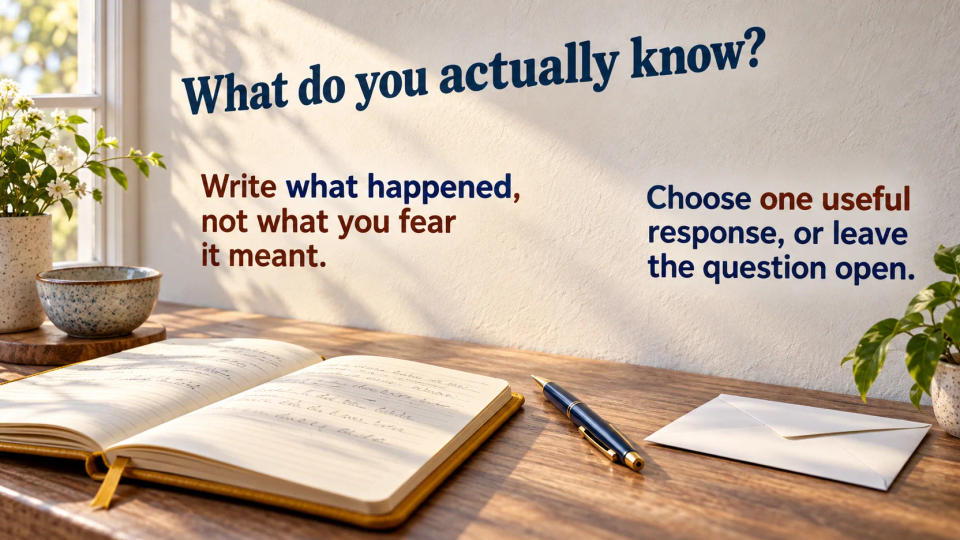
A note on paper can be more useful than another mental courtroom hearing. Draw two small columns. In the first, record only what a camera or microphone could have captured. In the second, put your interpretations. 'She looked at her phone after I spoke' belongs under facts. 'She was bored because of me' belongs under guesses.
Now ask whether other explanations fit. Perhaps she was checking the time, responding to a family message, or simply distracted. You do not need to select a cheerful explanation as the new truth. The point is to stop promoting an uncertain guess into an established fact.
The UK's NHS offers a similar approach in its thought record exercise: notice a difficult thought, look at supporting and opposing evidence, and consider a more balanced interpretation. For a casual social moment, you can keep it to three lines rather than turning it into a major self-improvement project.
A useful final line might read: 'I made a teasing comment, she smiled, and I don't know what she thought afterward.' It isn't a spectacularly reassuring sentence. That is precisely its strength: it stays within what you know.
Decide whether the situation needs action, not more analysis
Sometimes the loop points to a genuine loose end. Maybe you accidentally shared news that wasn't yours to tell. Maybe you dismissed a friend's worry or gave confusing instructions at work. If you can name one concrete issue, a brief repair may make sense: 'I realized that sounded dismissive earlier. I'm sorry—I didn't mean to brush off what you said.' Then give the other person room to respond.
But consider the opposite case: nothing specific happened except a pause, an ordinary change of subject, or a message that hasn't received a reply yet. A long apology for something the other person hasn't identified can create a new, uncomfortable conversation. So can asking three friends to assure you that your joke was fine.
Use this simple decision rule: Is there a clear action I can take that respects the other person and the facts? If yes, choose one proportionate action. If not, treat the remaining discomfort as uncertainty, not as another task to complete. The goal isn't to become someone who never makes mistakes; it is to be someone who can repair real ones without trying to control every impression.
Give your mind an ending it can actually use
A shift in activity won't rewrite the conversation, but it can interrupt the endless audition of alternative lines. After noting the facts and making any necessary decision, pick something with a beginning and an end: wash the dishes while listening to one song, walk around the block, water the plants, or prepare tomorrow's breakfast. Notice the floor under your feet and the temperature of the water instead of performing another imaginary dialogue.
For example, after a team lunch you might write: 'Fact: I talked over Sam once. Action: Let Sam finish next time; if it seemed dismissive, acknowledge it tomorrow.' Then close the notebook and return to your evening. If the same scene pops up again, remind yourself that you have already made the decision. You are allowed to leave the rest unresolved.
Try a small experiment after your next ordinary conversation. Give yourself a few minutes to identify one fact, one guess, and one possible action. If there is no action, move on to a physical activity you already planned. Don't score the experiment by whether the thought vanishes instantly; notice whether you spend less time feeding it with new questions.
If replaying interactions regularly disrupts sleep, relationships, or daily life, talking with a qualified mental health professional can be worthwhile. For the more occasional evening replay, remember this: being thoughtful about how you treat people is valuable. Conducting an endless investigation into what they might have thought is not the same thing as caring.