

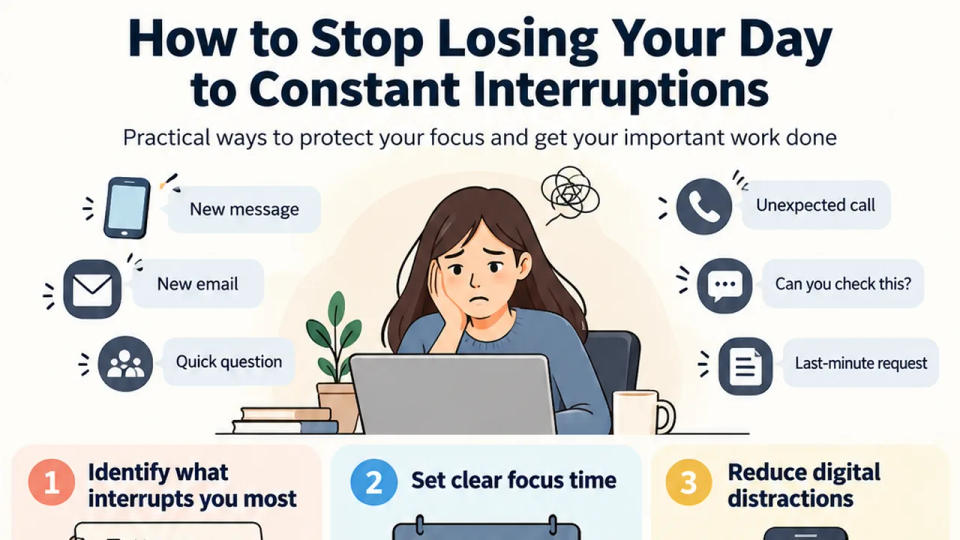
You can start the day with a sensible plan and still reach late afternoon wondering where the hours went. The problem is often not one dramatic distraction. It is a string of small interruptions: a coworker asks a quick question, a message appears, someone calls, a new request lands, and you remember something unrelated while trying to return to the original task.
The practical answer is not to make yourself unreachable all day. It is to reduce avoidable interruptions and make the unavoidable ones cheaper. A simple interruption system does three things: protects a few important focus periods, gives incoming requests somewhere to go, and leaves you a clear trail back to the work you were doing.
Why a Two-Minute Interruption Can Cost Much More Than Two Minutes
Most interruptions arrive looking harmless. “Can you check this?” sounds like a two-minute request. The hidden cost is the restart. You have to remember what you were deciding, reopen the right tab, reconstruct the next step, and resist whatever new task the interruption introduced.
That is why counting only the minutes spent answering people can be misleading. A better question is: How often did I have to rebuild my place? If you are interrupted six times during a writing session, the damage is not just six conversations. It is six separate returns to the draft.
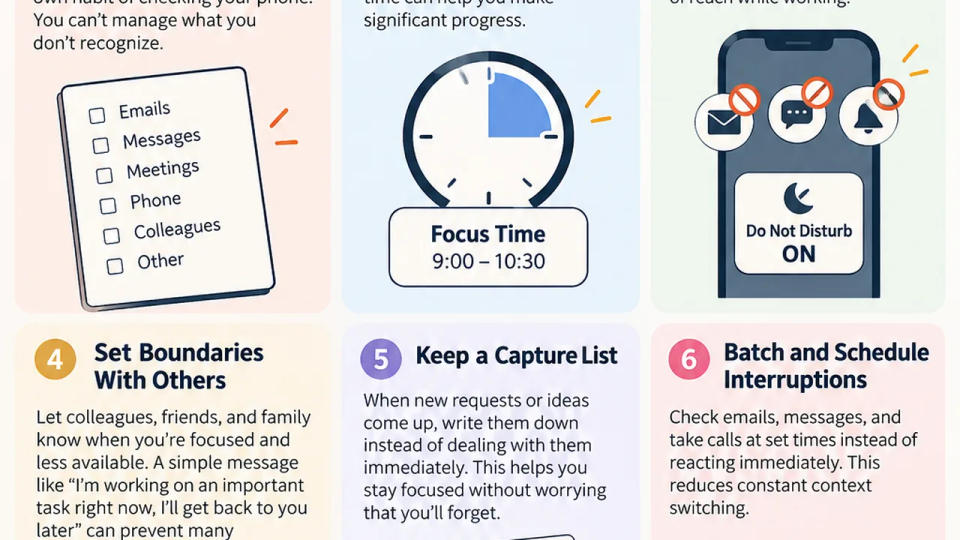
For one workday, keep a tiny interruption log. Do not turn it into another project. Write only the time, source, and whether it truly needed an immediate response. You may discover that the biggest problem is not notifications. It might be coworkers approaching whenever your door is open, family members assuming laptop time is flexible, or your own habit of switching tasks whenever a new thought appears.
Protect Focus With a Visible Response Boundary
“Do not interrupt me” is rarely practical. “I will respond at 11:30” is much easier for other people to work with. Instead of trying to create total isolation, create predictable response windows.
Choose one or two blocks for work that suffers when broken apart: writing, analysis, coding, planning, studying, design, or complicated administrative work. During those blocks, silence nonessential alerts and make your availability visible when possible. A status message such as “Focused until 10:30; checking messages after that” gives people useful information without requiring a long explanation.
Keep the blocks realistic. If your job involves frequent collaboration, a three-hour no-contact period may create more problems than it solves. A 45- to 90-minute protected block followed by a communication window is often easier to maintain. The goal is not maximum silence. It is enough continuity to finish a meaningful piece of work.
Use a simple urgency rule as well. Decide in advance what deserves an interruption: a customer issue that cannot wait, a safety problem, a deadline due within the hour, or a decision that is blocking several people. Everything else can enter the next response window. This removes the need to renegotiate your priorities every time someone says “quick question.”
Use a 30-Second Return Note Before You Switch
Some interruptions cannot be postponed. When that happens, protect your return before you turn away.
Take about 30 seconds and leave a restart note. Write the exact next action, not a vague description of the project. “Continue report” is weak. “Compare August and September conversion rates, then write the two-sentence explanation under the chart” is much better. If you were halfway through a decision, add the unresolved question: “Need to decide whether to remove the outlier before recalculating.”
This tiny note acts like a bookmark for your working memory. When you come back, you do not have to stare at the screen and ask, “Where was I?” You have an instruction waiting for you.
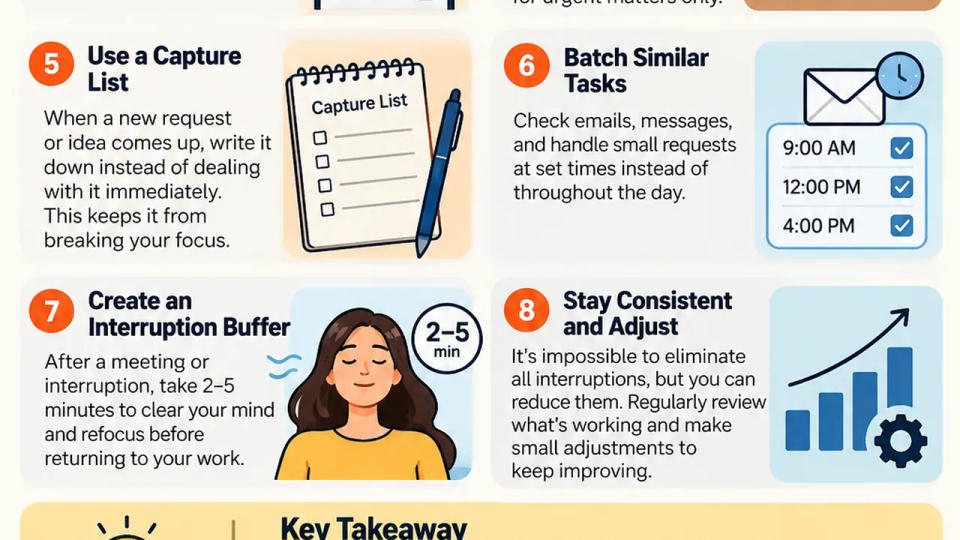
Use the same method for self-interruptions. If you suddenly remember that you need to book an appointment or send someone a file, put it on a capture list instead of doing it immediately. A trusted “later” list lets your brain release the reminder without turning every remembered task into a detour.
Batch the Interruptions You Can Predict
Not every interruption is random. Email, chat, approvals, routine questions, and small administrative requests often arrive throughout the day, but they do not necessarily require continuous attention.
Create two or three short communication windows and process these items together. For example, check messages at 10:30, after lunch, and near the end of the workday. If your role requires faster responses, shorten the interval rather than keeping every channel open every minute.
You can also reduce repeated questions by fixing the source. If teammates regularly ask where a file lives, make the location obvious. If clients keep asking about the same next step, add it to your standard update. If family members interrupt because they cannot tell whether you are working or taking a break, use a simple visible signal. Preventing one recurring interruption is more valuable than becoming faster at recovering from it.
Be careful not to turn batching into avoidance. Response windows should be dependable. When people learn that you really do check at the promised time, they have less reason to chase you through another channel.
Build an Interruption Recovery Routine You Can Use on Busy Days
A good system must survive messy days. Try this five-step routine: before focus work, define the next concrete outcome; during the block, route nonurgent requests to a later list; before an unavoidable switch, leave a 30-second return note; after the interruption, reopen only the materials needed for that note; at the end of the day, identify one repeated interruption you can prevent tomorrow.
Consider a realistic example. You are preparing a proposal due at 3:00 p.m. At 9:20, a colleague asks for a document. Instead of searching immediately, you capture “send budget template to Maya” and keep writing. At 10:00, a customer calls with an issue that genuinely needs attention. Before answering, you type: “Next: rewrite pricing paragraph using the approved numbers in tab 3.” Twenty minutes later, you return and start with that sentence instead of rereading the entire proposal.
The day was still interrupted. The difference is that the interruptions did not get to redesign the whole day.
Conclusion
You do not need perfect silence to do focused work. You need fewer unnecessary switches and a reliable way back after the necessary ones. Protect a realistic focus block, tell people when you will respond, capture requests that can wait, and leave an exact restart note whenever you must switch.
Start with one experiment tomorrow: protect one 60-minute block and use a return note for every interruption. At the end of the block, ask whether you spent less time reconstructing your place. That small change can make a busy day feel far less fragmented without requiring you to disappear from everyone around you.