


Some weeks look manageable on Sunday and impossible by Tuesday. A meeting runs long, someone needs help, an errand takes twice as long as expected, and the work that mattered most gets pushed to another day. Making a more detailed to-do list rarely fixes this. What you need is a personal time management strategy that still works when the week changes.
The practical answer is to design around your real available time, not the time you wish you had. Map your fixed commitments, choose a small number of weekly outcomes, protect a few flexible work windows, and decide in advance what you will do on crowded days. That creates a usable system rather than another ideal schedule to fall behind on.
Start with the week you actually have
Before choosing a productivity app or a color-coded calendar, look at an ordinary week. Include paid work or classes, commutes, meals, appointments, caregiving, exercise, and the errands that always seem to appear. Do not treat those hours as interruptions to your plan. They are part of your plan.
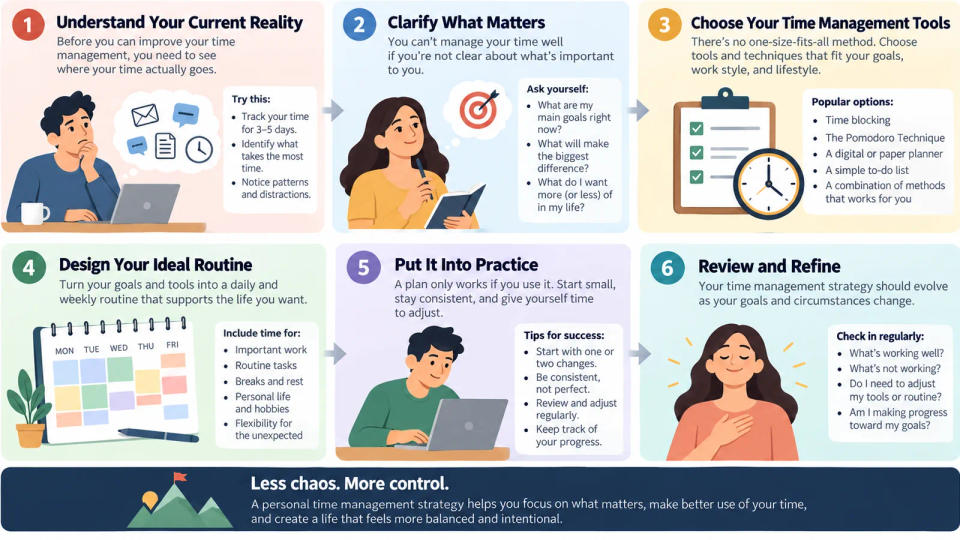
For three to five days, note when you intended to work on something and what really happened. You do not need minute-by-minute tracking. A few observations are enough: “Monday afternoon was broken up by calls,” “I can think clearly before the school pickup,” or “Thursday evenings are rarely free.” Record when you have uninterrupted time as well as when you do not.
Then separate your week into three kinds of space: commitments you cannot move, work windows you can reasonably count on, and uncertain time that sometimes appears. Only the second category belongs in your dependable capacity. If you regularly have two 45-minute windows for a personal project, plan for 90 minutes—not the six hours you hope might open up.

Leave some unassigned room for overruns and normal life. A buffer is not wasted time; it is what keeps one delayed appointment from turning the entire week into a recovery operation. How much you leave open depends on how unpredictable your days are. Someone with frequent customer calls will need a different margin from someone with mostly independent work.
Build a weekly framework, not a perfect timetable
A strategy should help you make choices without forcing you to decide everything again each morning. Start by naming two or three outcomes that would make the week worthwhile. Make them specific enough to recognize: finish the first draft of a proposal, complete two study chapters and their practice questions, or organize the documents for a housing application. “Be productive” is not an outcome.
Now match each outcome with a minimum useful session. A draft might need two 60-minute blocks; studying might fit three 35-minute sessions. Put those sessions into reliable windows first. Give fixed appointments their actual duration, including transition time, instead of letting the calendar pretend you can start focused work the second a meeting ends.
Keep the supporting routine small. For example, look at the next work window before you close your laptop, leave the relevant file or book ready, and keep one place to capture incoming requests. Those actions reduce the friction of beginning without requiring a complicated system of boards, labels, and alerts.
There is an important difference between a commitment and a preference. “Write for 45 minutes before Wednesday's meeting” may be a realistic commitment. “Always work for two hours before breakfast” may only be a preference if your mornings depend on family schedules. Put dependable commitments on the calendar; treat preferences as optional opportunities.
Give yourself three versions of a working day
Most plans have only one setting: the ideal day. That is why one unexpected event can make them feel broken. A more personal strategy has a normal-day plan, a crowded-day plan, and a disrupted-day plan. They share the same priorities but require different amounts of time.
On a normal day, use the session you reserved for the week's main outcome. On a crowded day, reduce the session to its smallest meaningful piece: outline the introduction, solve three representative problems, or review one application form. On a disrupted day, make a conscious choice between a five-minute handoff note and stopping completely. Both can be better than repeatedly telling yourself you will “catch up tonight.”
The decision rule is simple: if you have a clear 45 minutes, do the planned session. If you have only 15–20 minutes, complete a defined piece that makes the next session easier. If your available time is fragmented or you are responsible for something urgent, record the next physical step and reschedule once. Do not keep reopening the entire weekly plan.
This approach also clarifies what you are not going to do. If a new request cannot fit without removing an existing commitment, the choice is to defer, shorten, delegate when possible, or renegotiate a deadline. Quietly adding the request to an already full evening is not a time management strategy.
See how the system works in a messy real week
Imagine Maya, who works four days a week and helps an older relative with appointments. She wants to finish a professional certification module but has struggled to maintain a rigid evening study schedule. Her initial plan asks for seven study hours. On paper it fits; in practice, evenings are repeatedly taken over by errands or fatigue.
After reviewing a typical week, she finds two dependable 50-minute windows during lunch breaks on quieter days and a 40-minute slot on Saturday morning. She sets one outcome: complete the module's lesson and its practice test. The two lunch sessions cover the lesson; Saturday is reserved for the test. She leaves Tuesday evening unscheduled rather than treating it as guaranteed extra time.
On Wednesday, a relative's appointment replaces a study window. Her crowded-day version is a 15-minute review of the lesson notes. If even that becomes unrealistic, she writes “resume at example four” on the first page and moves the session to the next available window. She does not write a fresh seven-day plan or declare the week lost.
The point is not that Maya completed everything. She established what counted as progress under different conditions, where her realistic time existed, and what to do when it disappeared. You can use the same structure if you are a student with variable shifts, a parent working around pickups, or a freelancer whose calls move without much warning.
Test one week, then change one rule at a time
Try the strategy for one full week before deciding whether it suits you. At the beginning, write down your two or three outcomes, your real work windows, and the crowded-day fallback for each. Keep this on one page or in a single note. The goal is to make decisions easier to see, not to produce a beautiful planning document.
At the end of the week, ask three questions: Which work window really held? What repeatedly displaced it? What was small enough to get done on a difficult day? Keep what worked. If an hour-long session never happened, try two shorter ones or a different location. If a recurring appointment always overruns, increase the buffer around it. Change only one or two rules so you can tell what helped.
Watch for a warning sign: your system requires more time to maintain than it gives back. If you are transferring tasks between several apps, rewriting elaborate schedules, or checking progress constantly, simplify. One place for commitments, one short list of weekly outcomes, and one fallback rule may be enough.
A personal time management strategy is not a promise that every day will run smoothly. It is a way to decide what matters, make a realistic amount of room for it, and keep moving when circumstances change. Start with the week you have. Design the next one from what you learn.