


You get home from dinner, a meeting, or a quick chat with someone you know. The conversation seemed normal at the time. Then, while brushing your teeth or lying in bed, one sentence comes back.
Maybe you talked too much. Maybe your joke sounded strange. Maybe the other person paused for half a second and now you are wondering what that pause meant. Before long, you are mentally replaying the whole exchange, editing your lines and trying to work out what the other person really thought.
Looking back on a conversation can be useful. It can help you notice that you interrupted someone, missed an important point, or want to handle something differently next time. The problem starts when reflection stops producing anything new. At that point, you are no longer learning from the conversation. You are circling it.
If you want to stop replaying conversations in your head, the goal is not to force yourself to forget. A more realistic goal is to know when the review has become a loop, take whatever useful information is available, and give the conversation an ending.
Notice What You Are Actually Trying to Solve

Most mental replays start with a question that sounds reasonable: “Did I say something wrong?” But if you keep going, the question often changes. It becomes “Did they think I was awkward?” or “Are they annoyed with me?” or even “What does this say about me?”
That is an important shift. You may remember what you said, but you usually cannot know exactly what another person thought about it. Once the mind starts trying to solve that unknown, almost any detail can become evidence. A short reply can seem cold. Someone checking the time can seem like boredom. A neutral expression can suddenly look critical.
When you notice this happening, ask yourself one practical question: Is there a real problem here that I can act on, or am I trying to get certainty about someone else’s private reaction?
If there is a clear problem, action may help. Perhaps you forgot to answer a question, made a comment you genuinely regret, or promised to send something and did not. Those situations have a next step. You can clarify, apologize briefly, or follow through.
If there is no specific action to take, continuing to analyze the conversation may only create more possibilities to worry about.
Separate What Happened From What You Added Later
One of the easiest ways to make a conversation feel worse is to mix facts with interpretation.
Suppose you spoke during a team meeting and your manager did not react much. The fact is simple: you shared an idea, your manager listened, and the meeting moved on. The story that may appear later is much bigger: “They hated the idea. I sounded unprepared. Everyone noticed.”
Try a quick two-column check in your head or on paper. On one side, write what you actually know. On the other, write what you are assuming.
What I know: I stumbled over one sentence. She looked at her laptop. We continued the conversation normally.
What I am assuming: I embarrassed myself. She was judging me. I ruined the impression I had made.
This is not about replacing every uncomfortable thought with a cheerful one. You are simply putting uncertainty back where it belongs. “I do not know what she thought” is often more accurate than either “She definitely hated it” or “Everything was perfect.”
That small distinction can stop your imagination from turning an ordinary social moment into a verdict on your entire personality.
Give Yourself a Short Debrief, Then Close the File
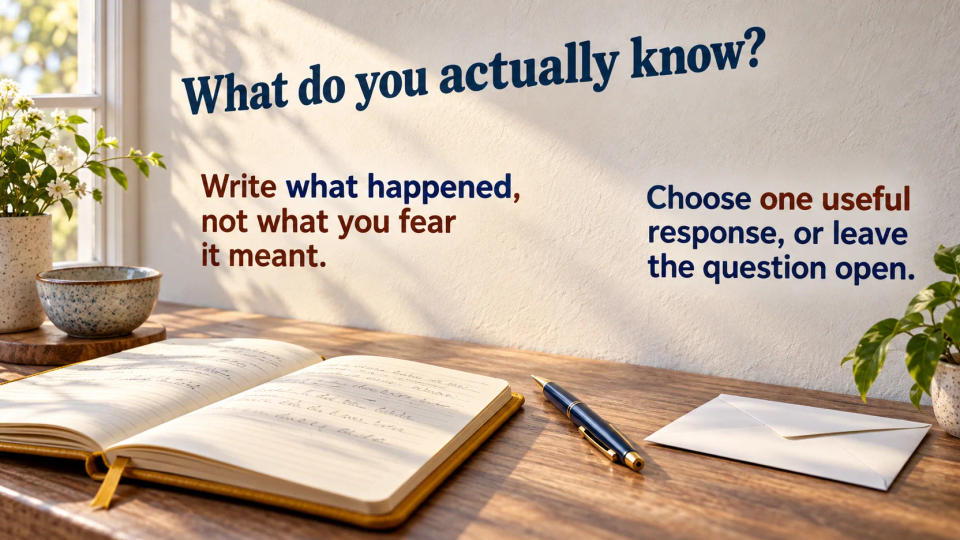
If your mind keeps returning to the same interaction, it can help to give the conversation a limited review instead of arguing with yourself for hours.
Set aside five or ten minutes and answer three questions:
- What actually happened?
- Is there anything useful I want to do differently next time?
- Is there any action I need to take now?
For example: “I interrupted twice because I was excited. Next time I want to pause before jumping in. I do not need to send an apology because the conversation stayed friendly and no one was harmed.”
That is reflection. It produces a takeaway and then stops.
If your mind returns to the same conversation later, you do not have to reopen the whole case. You can remind yourself, “I already reviewed this. I know my takeaway.” Then move your attention to something concrete: showering, washing dishes, reading a few pages, preparing tomorrow’s bag, or taking a short walk.
Stop Reopening the Conversation
It is natural to ask someone you trust, “Did that sound rude?” once in a while. A second opinion can be useful when there is genuinely something to clarify.
But repeated reassurance can turn into another version of the same loop. You tell the story, feel better for a few minutes, remember one more detail, and ask again. Then you start explaining your tone, the exact pause, or where everyone was sitting.
A useful decision rule is this: ask once when another perspective could realistically change what you do. If the answer will not change your next step, you probably do not need another round.
The moments when replaying gets strongest are often the quiet ones: the commute home, the shower, the hour before sleep. It helps to have a small closing routine ready before you need it.
You might write one sentence in a notebook: “Nothing to fix; next time I will slow down.” You might put your phone on charge across the room, make tea, and switch to a familiar book. After a difficult work conversation, you might take a ten-minute walk before going home so your body has a clear transition from the interaction to the rest of your evening.
You can also use a simple phrase that does not try to convince you that everything was perfect: “That conversation is over. If something needs attention, I can deal with it when I have new information.”
You are not proving that nobody misunderstood you. You are deciding that you do not need to keep investigating without new evidence.
Over time, this becomes a useful habit: review what matters, repair what genuinely needs repair, learn what you can, and let the rest remain uncertain.
If replaying conversations is frequent enough to disrupt your sleep, work, relationships, or daily life, it may be worth talking with a qualified mental-health professional. Lifestyle strategies can help with everyday overthinking, but you do not have to manage persistent distress on your own.
Conclusion
You do not need to stop caring about how you come across. The more useful skill is learning the difference between reflection and repetition.
Reflection gives you something: a lesson, a decision, an apology, or a clearer plan for next time. Repetition keeps asking the same question when no new information is available.
When you catch yourself replaying a conversation, identify the real question, separate facts from guesses, decide whether action is needed, and then close the review. The conversation may still pop back into your mind later. That is fine. You can notice it without giving it another hour of your evening.