


Some days feel messy before anything truly dramatic has happened. There are dishes in the sink, three messages you forgot to answer, a work task that keeps getting pushed back, laundry waiting in a basket, and one decision you still have not made. None of those things is huge on its own, yet together they can create the feeling that your whole life is slipping out of your hands.
The fastest way to feel more in control is usually not to fix everything. It is to make the situation smaller. When you reduce the number of things you are trying to hold in your head, choose what actually needs action, and create one or two reliable points in your day, life starts to feel workable again. The goal is not perfect order. It is enough structure to know what to do next.
Make the problem smaller before you try to solve it
When life feels messy, the mind tends to turn several separate problems into one giant problem called “everything.” That makes it hard to begin because there is no clear starting point.

Instead of asking, “How do I get my life together?” ask a narrower question: “What are the three things making today feel most chaotic?” You might write down overdue work, a cluttered kitchen, and an unresolved conversation. That list is already easier to look at than the vague feeling that everything is wrong.
Then shrink each item again. “Overdue work” becomes “open the document and write the first 200 words.” “Cluttered kitchen” becomes “clear the counter and load the dishwasher.” “Unresolved conversation” becomes “decide whether I need to reply today.” A smaller problem gives you somewhere to place your attention.
This matters because control often returns before the situation is fully solved. It returns when you can see the next move.
Separate what needs action from what needs acceptance
A messy period usually contains two kinds of stress: things you can influence and things you cannot settle right now. Mixing them together creates unnecessary pressure.
Try a simple two-column check. On one side, write what you can act on today. On the other, write what is real but not currently yours to control. You can send the email, make the appointment, cancel a commitment, wash the clothes, or ask for clarification. You cannot control when someone replies, whether another person changes their mind, how quickly a company makes a decision, or whether every plan unfolds neatly.
The point is not to become detached. It is to stop spending the same amount of energy on both columns. If something is actionable, give it a next step. If it is not, give it a boundary: “I will check again Friday,” “I will wait for the reply,” or “I am not making another decision about this tonight.”
That boundary keeps uncertainty from taking over every spare moment.
Reset one visible part of your day
When your surroundings and schedule both feel scattered, pick one visible area that affects you repeatedly. It could be the kitchen counter, the chair covered in clothes, your work desk, the entryway, or even the browser tabs you keep reopening.
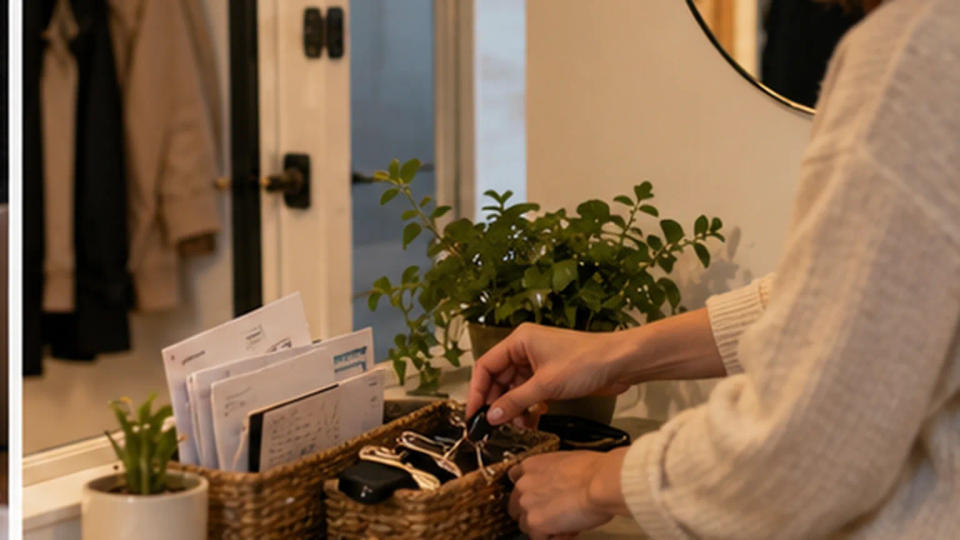
Do not turn this into a whole-house project. Set a small finish line. Clear enough of the desk to work tomorrow morning. Put keys, wallet, and bag in one place. Wash only what you need for breakfast. Close the tabs you are not using. The value is not that the area looks impressive. It is that the next interaction with that space becomes easier.
For example, imagine you come home after a long day and the apartment is untidy. You could spend the evening trying to catch up on everything, become irritated halfway through, and go to bed feeling behind. Or you could spend ten minutes clearing the kitchen counter, prepare your coffee mug for the morning, and leave the rest for another day. One finished area can feel more stabilizing than five half-started jobs.
Create a “minimum day” for chaotic weeks
People often make their routines more complicated when life is already overloaded. They design a perfect morning, a detailed workout plan, a full meal-prep schedule, and a long productivity system. Then they miss one part and feel even less in control.
A better approach is to decide what a minimum functional day looks like. Keep it small enough that it still works when your energy is low. Your version might be: get dressed, eat something real, choose one priority, spend ten minutes resetting the home, and prepare one thing for tomorrow.
This is not a permanent lifestyle standard. It is a floor. When life is calm, you can do more. When life is messy, you still have a few anchors that prevent the day from becoming completely reactive.
If you live with family or share a home, the same idea can be practical there too. Instead of trying to keep every room perfect, agree on a few basics that make daily life easier: dishes handled before bed, bags ready near the door, one calendar checked in the evening, or a short Sunday reset. Reliable basics often matter more than ambitious systems.
Use a next-step rule when you want a complete plan
One reason messy seasons feel so uncomfortable is that we want certainty before we begin. We want to know how the project will end, whether the relationship will improve, what the right decision is, or when life will feel normal again.
Most of the time, you do not need the whole plan. You need a rule for choosing the next useful action. Try this: when you feel stuck, choose the step that is small, reversible, and likely to make tomorrow easier.
That might mean paying one bill instead of rebuilding the entire budget, sending one clarifying message instead of replaying a conversation, buying groceries for three simple meals instead of redesigning your diet, or writing down tomorrow’s first task instead of planning the whole week.
At the end of the day, do a two-minute review. Ask: What did I close today? What still matters tomorrow? What can wait? This keeps unfinished tasks from automatically turning into mental clutter.
Conclusion
Feeling more in control does not require a perfectly organized home, an empty inbox, or a week with no surprises. It comes from knowing what deserves your attention, what can wait, and what you are choosing not to carry right now.
When life feels messy, make the problem smaller, separate action from uncertainty, reset one visible area, and rely on a minimum routine instead of an ideal one. You may still have loose ends, but you will have a clearer place to stand while you deal with them.